SEO Performance: Metrics and Benchmarking for 2026
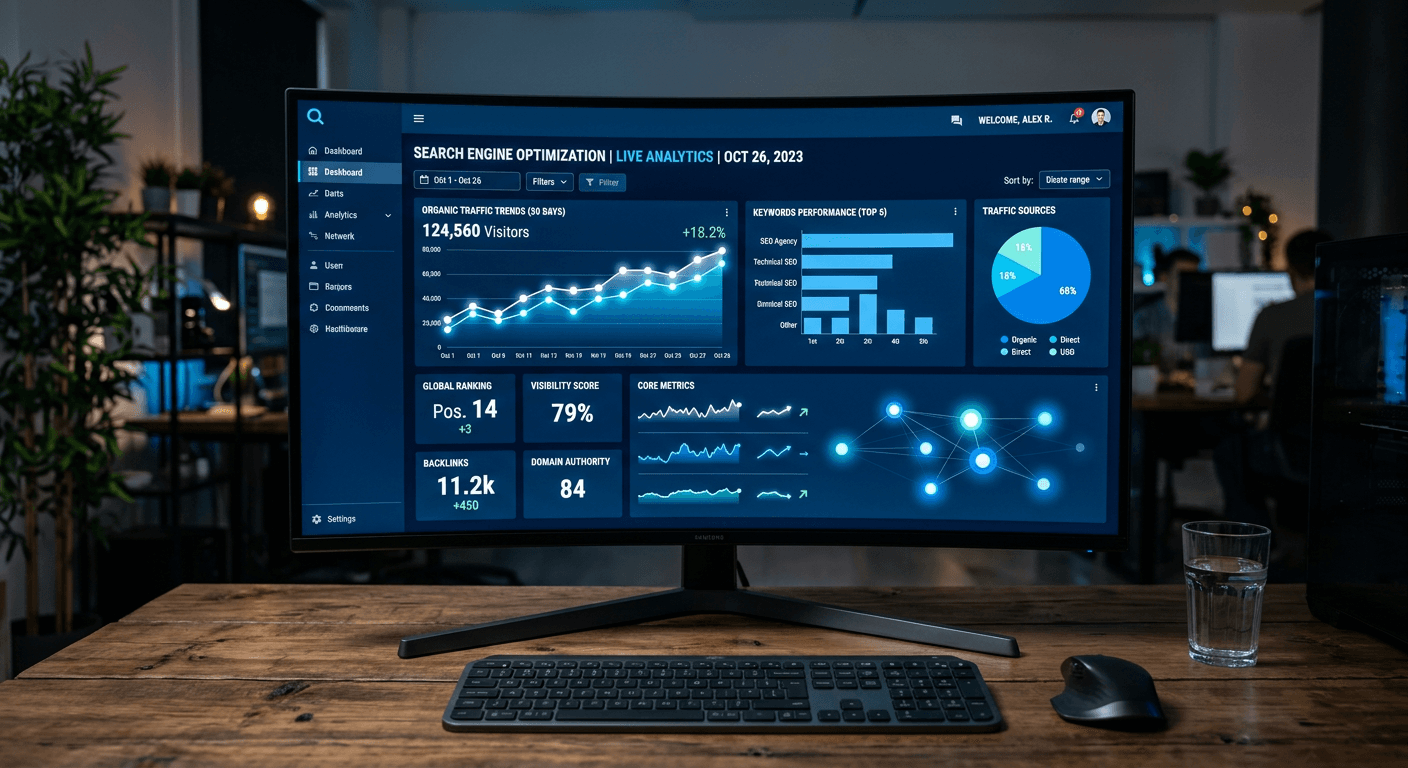
Mastering seo analytics in 2026 requires moving beyond vanity metrics toward a sophisticated, data-driven approach that correlates search behaviour with tangible business outcomes. By leveraging robust seo metrics and establishing precise seo benchmarks, digital strategists can cut through market noise to identify growth opportunities. Understanding your current standing via a free site audit is the essential starting point for any high-performance search engine strategy.
Quick Summary {#quick-summary}
SEO performance measurement in 2026 involves the integrated analysis of organic traffic quality, engagement depth, and conversion efficacy. Success is no longer defined by rankings alone, but by a holistic seo visibility score that accounts for AI-generated search results, user intent, and technical health.
- Prioritise engagement-based metrics over simple keyword rankings.
- Utilise advanced seo tracking tools to monitor AI search feature saturation.
- Set benchmarks based on industry-specific conversion rates rather than historical averages.
- Regularly assess technical infrastructure via a professional site assessment.
Table of Contents {#table-of-contents}
- Understanding SEO Analytics Foundations
- Key SEO Metrics for 2026 Performance
- Establishing Effective SEO Benchmarks
- The Role of SEO Tracking Tools
- Analysing SEO Visibility Score and AI Search
- Google Analytics SEO Integration
- FAQ
- Recommended Reads

Understanding SEO Analytics Foundations {#understanding-seo-analytics-foundations}
In the current landscape, seo analytics has shifted from a retrospective look at traffic volume to a predictive discipline. The modern practitioner must synthesise data from multiple touchpoints to understand the user journey before, during, and after a search query. This requires a transition from aggregate reporting to granular segment analysis, where performance is evaluated based on user intent clusters rather than broad keyword groups.
Foundational success rests on data integrity. Without accurate tracking, businesses risk making high-stakes decisions based on corrupted signals. Establishing a privacy-compliant data architecture ensures that your analytics remain robust against browser restrictions and tracking prevention measures that are increasingly common in modern web environments. If your data collection methods are flawed, every downstream optimisation effort will suffer from inaccuracies.
Key SEO Metrics for 2026 Performance {#key-seo-metrics-for-2026-performance}
While traffic volume remains a baseline indicator, it is no longer the primary driver of success. To evaluate true performance, focus on 'Value-per-Visit' and 'Conversion Attribution'. These metrics help determine which search terms are actually contributing to revenue or lead generation, effectively separating high-intent traffic from low-value curiosity searches.
Another critical metric is 'Search Engine Results Page (SERP) Real Estate'. This measures the physical space your brand occupies within the SERP, encompassing organic results, featured snippets, and video integrations. When assessing these, consider the following:
- Engagement Rate: Monitoring how long users spend on a page after clicking an organic result.
- Keyword Intent Mapping: Categorising rankings by informational, transactional, or navigational intent.
- Technical Vitality: Tracking Core Web Vitals to ensure site performance does not erode search trust.
Pro Tip: Do not treat all organic traffic as equal. Filter your reporting to exclude branded search terms when benchmarking growth, as branded traffic fluctuates based on offline marketing efforts and brand awareness, not search engine optimisation efficacy.
Establishing Effective SEO Benchmarks {#establishing-effective-seo-benchmarks}
Seo benchmarking provides the context necessary to translate raw data into actionable insights. A growth rate of 10 per cent is meaningless without knowing if the industry standard for your vertical is 5 per cent or 50 per cent. By comparing your performance against your own historical data and your direct competitors, you identify realistic targets for future quarters.
Effective benchmarking involves segmenting your data by product line, content type, or geographic region. This granular approach prevents the 'averaging trap', where strong performance in one area masks systemic failure in another. Remember to update your benchmarks annually; static goals lead to stagnation in an industry that evolves as rapidly as search engine algorithms.
The Role of SEO Tracking Tools {#the-role-of-seo-tracking-tools}
Modern seo tracking tools must be capable of processing vast datasets and presenting them as intuitive visualisations. The most effective tools now include predictive modelling features that forecast potential rank decay or traffic surges based on historical trends. When choosing a platform, ensure it offers robust API integrations with your primary business intelligence software, allowing for cross-departmental data transparency.
Integration is vital because SEO data shouldn't live in a silo. When you connect your organic search data with CRM or internal sales data, you bridge the gap between 'search' and 'money'. This unified view is what elevates an SEO specialist from a tactical executor to a strategic business partner who understands the bottom-line impact of every search query.
Analysing SEO Visibility Score and AI Search {#analysing-seo-visibility-score-and-ai-search}
Your seo visibility score is the most comprehensive measure of your organic footprint. In 2026, this score is increasingly influenced by how well your content satisfies Large Language Model (LLM) training data and AI-driven summary engines. Because AI search interfaces often prioritise direct answers, your content must be structured to provide concise, authoritative information that can be easily parsed by automated systems.
Monitoring this score requires looking at the 'Answerability' of your content. Are your pages providing the definitive answer to the user's question? If your content is too verbose or lacks clear structure, search engines may surface a competitor's more succinct snippet instead. Use structured data markup to help search engines understand the relationships between your entities, significantly increasing your chances of capturing visibility within AI-generated search environments.
Google Analytics SEO Integration {#google-analytics-seo-integration}
Effectively using google analytics seo data requires moving beyond standard reports and creating custom exploration funnels. By mapping organic traffic paths to specific conversion actions, you can prove the ROI of your SEO investment. This is where you determine whether your high-performing pages are merely attracting traffic or actually driving business objectives like whitepaper downloads or newsletter sign-ups.
Standard reports often hide the complexity of the user journey. By creating custom segments, you can identify how organic visitors interact with your site differently than paid or social visitors. Use these insights to refine your content strategy; if visitors from organic search spend less time on-page, it may suggest a mismatch between search intent and landing page content that requires immediate adjustment.
FAQ {#faq}
-
How often should I review my SEO metrics? Weekly monitoring of core performance indicators is recommended for detecting sudden shifts, while a deep-dive, strategic review should occur monthly to inform ongoing content planning.
-
Why is my organic traffic declining despite stable rankings? This often indicates that your competitors are capturing more of the search real estate through rich snippets, video integrations, or improved AI search visibility, resulting in a lower click-through rate even if your rank hasn't moved.
-
What is a good SEO visibility score? There is no universal number, as it depends on your specific market. Use your site audit results to determine your baseline and set a target of 5-10% growth per quarter for the coming year.
-
Do I need advanced SEO tracking tools for a small site? Even for small sites, essential tracking tools are necessary to monitor technical errors and crawl issues. Without them, you are effectively operating blind to the technical health of your digital asset.