4 UK Agencies for Cheap SEO Optimization in 2026
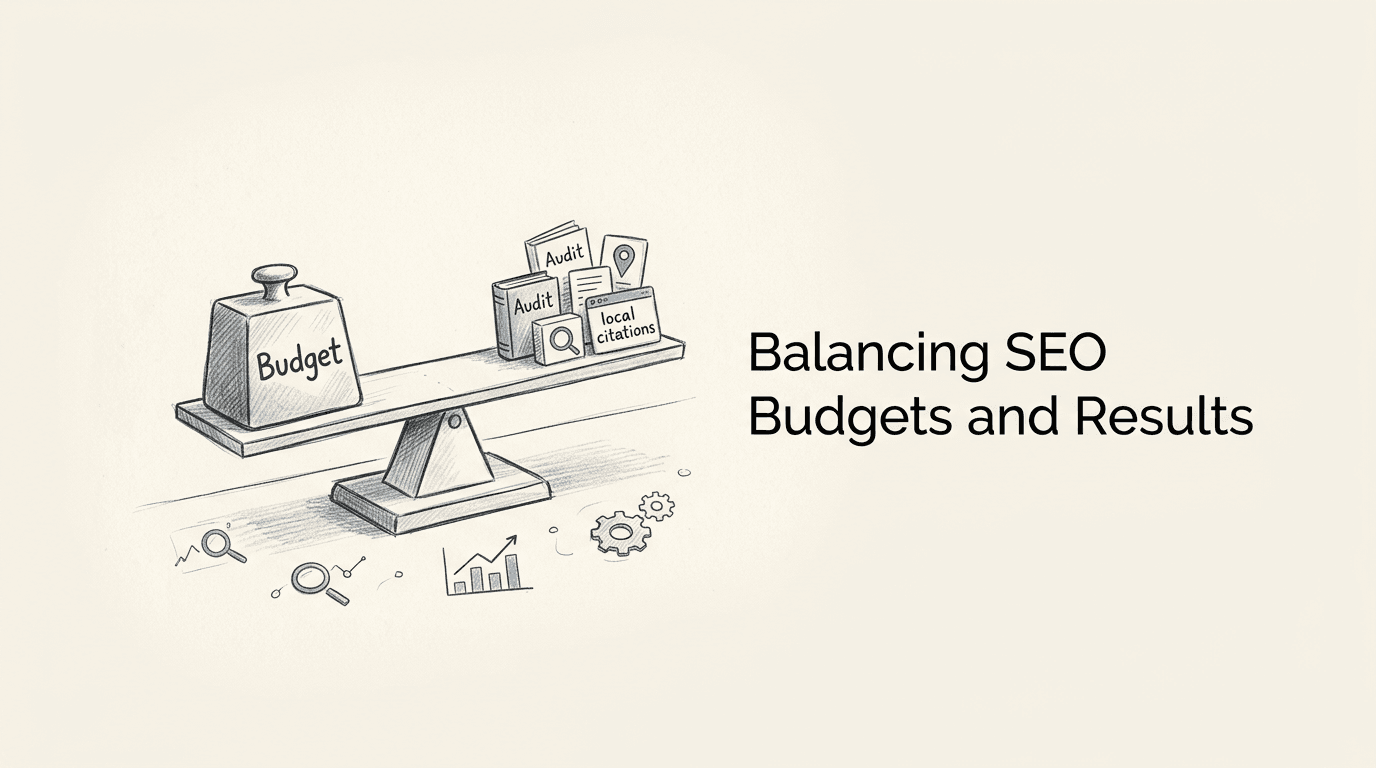
A regional SME director sits reviewing a digital marketing proposal, staring at a required monthly retainer that completely consumes their marketing budget for a standard search campaign. Such demands create deep operational friction. The business needs local visibility to capture search intent, but allocating that volume of capital simply breaks the profit margins of a low-volume physical service. That exact scenario sends leadership teams hunting for cheap seo optimization. However, the market for low-cost search visibility is complex and heavily fragmented. The following examines how affordable seo optimization actually functions in the UK market, the structural compromises you must accept when budgets shrink, and how to allocate limited funds without triggering algorithmic penalties.
Quick Summary
Cheap search visibility relies on tightly scoped deliverables, usually trading comprehensive strategy for specific, isolated actions like local profile management or one-off site audits. Approaching an agency for an seo low cost solution means choosing exactly which technical or content deficits to ignore.
- Scope restriction replaces strategy: Low budgets buy executed hours, not holistic campaign management.
- Commercial terms vary: You must decide between rolling micro-retainers or distinct pay-as-you-go projects.
- Execution liability shifts: Fixed-project structures often leave the implementation work to the business owner.
- Link risks escalate: Substandard budgets cannot fund a safe, manual outreach campaign.
Table of Contents
- The Hidden Cost of Cheap SEO Optimization
- 1. Wrise
- 2. Phoenix Web Services
- 3. Ready Steady Go SEO
- 4. True SEO
- Why the Delivery Model Dictates Your Success
- FAQ
- Recommended Reads
The Hidden Cost of Cheap SEO Optimization
| Product | Service Delivery Model | Features | Pros | Cons | Target Audience |
|---|---|---|---|---|---|
| Wrise | Monthly Rolling Contract | Local citation alignment, slow content drips | No setup fee, cancel anytime | Low velocity, limited technical depth | High-street retailers, local trades |
| Phoenix Web Services | Monthly Rolling Contract | WordPress redesign, essential on-page setups | Bypasses retrofitting, fixed instalments | Tied to WordPress | Businesses with legacy sites blocking search |
| Ready Steady Go SEO | Pay-As-You-Go / Project-Based | Finite technical audits, meta rewriting | No rolling fees, clear deliverables | Leaves execution to owner | Teams with internal marketing staff |
| True SEO | Full-Service Package | Semantic search mapping, topical content silos | Builds deep authority, KPI-driven | High cost floor | Regional businesses scaling nationally |
Before evaluating specific providers, it is necessary to understand the mechanics of search pricing. Every agency sells time, technical knowledge, and network access. When a provider reduces their fees to accommodate a constrained budget, they must remove one of these pillars to maintain their own commercial viability. This creates a classification axis we call the Service Delivery Model, which separates providers into three distinct categories: Monthly Rolling Contract, Pay-As-You-Go / Project-Based, and Full-Service Package.
When you operate under a Monthly Rolling Contract, the agency limits the hours deployed per month. They execute small, continuous updates. A Pay-As-You-Go / Project-Based arrangement fundamentally alters the relationship: the agency delivers a finite set of technical instructions or a one-off audit, and the engagement ends entirely. A Full-Service Package retains the holistic approach of an enterprise retainer but restricts the regional scope or keyword volume to keep costs grounded.
Practical rule: Never buy an undefined retainer. If a low-cost agency cannot list the exact deliverables your monthly fee covers - such as a specific number of pages audited or profiles built - they are selling a reporting dashboard rather than execution.
One common failure mode in this space is assuming that low-cost providers can safely manipulate domain authority. Safe link acquisition requires manual outreach, relationship management, and financial compensation to publishers. Consequently, an agency offering a cheap package cannot deploy a high-quality link campaign. If they try, they are likely deploying automated software to place links on compromised or entirely artificial domains. You should always utilise a free site audit to map your current technical debt before allowing a low-budget provider to alter your link profile. If your internal team lacks the capacity to manually execute foundational updates safely, adopting an AI-driven SEO platform for UK businesses can automate the deployment of local signals and technical patches without incurring agency overheads.
1. Wrise
A local retailer operating in Manchester needs to rank for regional commercial intent, but locking into a rigid twelve-month agreement presents an unacceptable cash flow risk. Wrise operates as an independent provider delivering contract-free search engine optimisation tailored explicitly for smaller enterprises that need flexibility.
Their Seed plan, published at £99 per month plus VAT with no setup fee, functions by distributing small, incremental improvements over a long timeline. Rather than executing a massive technical overhaul in month one, this approach drips minor on-page adjustments, local citation alignment, and basic Google Business Profile management month by month. Search engines rely on a consistent Name, Address, and Phone Number data structure across directories like Thomson Local and Yell to verify a business's legitimacy. Wrise ensures this foundation is flawless over time. They rely on compounding small gains, which allows clients to cancel at any time, moving the commercial risk away from the buyer.
Low commercial risk trades off against timeline velocity
The structural limit of a £99 budget is human capacity. At standard UK commercial rates, this fee buys barely an hour or two of expert practitioner time per month. It cannot cover deep technical redevelopment, nor can it fund a dedicated seo backlinking service to build domain authority. What would make us hesitate here is attempting to deploy this strategy in a hyper-competitive national niche, as the low velocity simply cannot outpace established competitors. Businesses operating against heavily funded rivals will find this ceiling too restrictive.
We would choose this model if securing foundational local visibility is the only immediate goal and cash flow preservation is paramount.
Pros
- No long-term contractual lock-in required.
- Eliminates setup fees entirely.
- Shields tight cash flow from massive upfront costs.
Cons
- Insufficient hours for deep technical audits.
- Cannot fund aggressive link acquisition.
- Growth velocity is inherently slow.
2. Phoenix Web Services
Often, the trigger event that sends a business looking for search help is the realisation that their legacy website simply cannot be indexed properly by search engines, regardless of how much content they add. Based in Ely, Phoenix Web Services bundles custom website creation with foundational search adjustments, acting as a hybrid solution for independent practitioners.
What happens mechanically during a fresh build? Phoenix Web Services delivers custom WordPress website design packages. These builds inherently include essential on-page optimisation. Clients pay in monthly instalments starting at £150 per month on rolling contracts. By controlling the build environment, they ensure early compliance. Site architecture, meta structures, and internal linking frameworks align with search crawler requirements from day one. Retrofitting a broken architecture is often more expensive than starting fresh. Phoenix Web Services addresses this by enforcing canonical tags correctly from the start. Search crawlers therefore do not waste budget on duplicate category pages. They compress media assets during the build phase. The resulting site clears Google's mobile usability thresholds.
Bundling design with search foundations prevents retrofitting
This approach is entirely constrained by the platform and the scope of work. It assumes WordPress is the correct content management system for your operations. If you run a complex e-commerce operation requiring bespoke software applications, this infrastructure is incompatible. Our primary hesitation is that basic on-page alignment does not solve off-page authority deficits; it merely ensures your site is technically legible to search algorithms.
We would select this when a deeply flawed legacy architecture is actively blocking indexation and a clean break is required.
Pros
- Prevents spending money optimising broken code.
- Instalment billing smooths capital expenditure.
- Ensures mobile usability compliance immediately.
Cons
- Restricts platform choices to WordPress.
- Does not address ongoing off-page authority.
- Content creation remains your responsibility.
3. Ready Steady Go SEO
Rather than signing an open-ended retainer, many directors ask a distinct question before shortlisting an agency: can we just fix what is currently broken without paying a monthly fee forever? Ready Steady Go SEO replaces the standard retainer model entirely, delivering distinct search improvement scopes on a standalone basis.

The Gloucestershire-based consultancy prices most of its core packages at £340 plus VAT per project, specifically bounding this effort to websites of up to 15-20 pages. The mechanism here is a finite technical and content audit followed by bounded execution. During a standard project, they run comprehensive crawler tools to map existing errors. They locate orphan pages that lack internal links, rewrite meta descriptions to capture a higher click-through rate, and restructure heading tags to create a logical topical hierarchy. There is no ongoing reporting overhead, no continuous link acquisition, and no monthly billing cycle to manage.
A fixed scope protects constrained budgets from scope creep
A standalone project fundamentally leaves ongoing maintenance to the business owner. Search algorithms update constantly, and competitors adjust their content daily. Because there is no rolling monitoring, any ranking degradation that occurs three months after the project finishes will go unnoticed unless you track it yourself. We would not recommend this model to teams operating without internal technical resource, as they will lack the capacity to maintain the initial gains once the agency hands the domain back.
We would hold off on this approach if the internal team lacks the capacity to monitor search console data after the engagement ends.
Pros
- Caps total financial exposure immediately.
- Delivers clear, measurable technical fixes.
- Removes agency account management fees entirely.
Cons
- Provides zero ongoing algorithmic monitoring.
- Ceilings at 20 pages for the core package.
- Forces internal staff to handle future updates.
4. True SEO
The bottleneck many scaling companies face is not a lack of technical compliance, but a fundamental lack of topical depth compared to entrenched market leaders. True SEO is a Cardiff-based digital consultancy that shifts the focus away from basic fixes and toward comprehensive semantic strategies.
Their local campaigns begin at £399 per month, while their full-service plans are published at £699 per month. Instead of basic keyword insertion, the mechanism relies on KPI-driven semantic alignment. Search algorithms have moved away from exact matching toward entity recognition. True SEO maps the specific entities associated with your primary commercial offering, then builds interconnected content silos that cover every related question. They also provide a complimentary 30-minute strategy session to review existing organic search metrics before deployment, ensuring the semantic map matches the business's commercial objectives rather than just chasing blind traffic volume.
Semantic search mapping demands deeper financial commitment
Building topical authority requires significant research and content production, pushing the cost floor up. At £699 per month for a full-service plan, this option entirely prices out micro-businesses, side projects, and early-stage sole traders operating with zero marketing budget. Our concern for early-stage companies is that this model demands consistent operational cash flow over several quarters before generating a return. If you cannot sustain the fee for six months without seeing immediate revenue, this path is too dangerous.
We would commit to this structure if the market requires deep, interconnected content clusters to displace entrenched national competitors.
Pros
- Targets high-value semantic entities accurately.
- Builds compounding, long-term topical authority.
- Strategy session aligns technical work with commercial KPIs.
Cons
- Imposes a significantly higher financial floor.
- Demands long-term operational cash flow.
- Yields slower initial results than paid media.
Why the Delivery Model Dictates Your Success
When you operate within a Monthly Rolling Contract, your primary advantage is flexibility. If your commercial environment is volatile and you cannot predict your cash flow three months ahead, this structure ensures you are not legally bound to a marketing expense you can no longer afford. It suits high-street retailers and local trades perfectly, provided they understand the timeline will be significantly extended.
Choosing a Pay-As-You-Go / Project-Based approach changes the internal resource requirements. This category is optimal for businesses that already employ a marketing assistant or a junior developer. The agency provides the initial technical heavy lifting and the strategic roadmap, and your internal staff take over the continuous monitoring. It is a highly efficient way to deploy an seo low cost budget without wasting funds on an agency's account management overhead.
Committing to a Full-Service Package remains the necessary path for regional businesses attempting to capture national market share. When competitors are aggressively publishing content and running sophisticated campaigns, a piecemeal project will not bridge the gap. You must balance the higher monthly cost against the reality that basic tweaks cannot invent domain authority out of thin air.
FAQ
Can I get effective seo for cheap if my site is small?
Yes, providing your expectations align with the budget. A small website with a dozen pages can be technically optimised through a one-off project fee. However, maintaining competitive rankings against larger businesses will eventually require ongoing content investment.
What are the risks of using an unverified backlinking service?
An unverified provider charging abnormally low fees typically uses automated software to place links on compromised domains or private blog networks. This approach triggers algorithmic penalties from Google, effectively removing your site from search results entirely and requiring expensive remediation to fix.
Is an seo pay on results model safer for small businesses?
Not necessarily. While it sounds risk-free, an agency operating an seo pay on results structure often targets low-volume, irrelevant keywords simply to trigger the payment clause. The traffic generated rarely converts into commercial revenue, and the tactics used are often aggressive and short-term.
Why do agencies insist on technical audits before starting work?
An audit reveals the structural barriers preventing search engines from reading your site. Applying off-page authority or new content to a site with severe technical debt is ineffective, which is why reputable providers map the architecture first.